example · animated svg
Ambient geometric loop
Fifteen tiles that spin, scroll and ripple on one shared beat. Recreated from a 2.28 second screen recording: same shapes, same motion, new palette.
The recreation, live
rendering in your browser right now · 14 KB of vector · zero JavaScript

prefers-reduced-motionOriginal vs recreation
one clip, phase-aligned, so the beats land together

Original animation from SVGator’s website-animation examples — all credit to the original creator. Captured as a screen recording; nothing was traced or copied.
What the numbers measured
a still frame shows every shape and no timing — this is the part you cannot eyeball
| Grid | 5 × 3 tiles of 267 px, inset at (18, 9) — the artwork is not flush to the frame. Found from the strongest vertical/horizontal edges. The first guess (flush 277 px tiles) was wrong, and made neighbouring tiles bleed into each other. |
|---|---|
| Beat | 0.75 s. Burst peaks at 0.317 / 1.067 / 1.817 s, agreeing to ±0.02 s across three independent tiles. |
| Character | Short eased ticks, then a hold — not constant velocity. |
| Easing | Peak angular speed is ~3.6× the mean — too sharp for a stock ease-in-out. cubic-bezier(.83,0,.17,1). |
| Cadence | Most tiles tick every beat; the half-plane, pie wedge and L-morph tick every second beat. |
| Stagger | ~41 ms top-to-bottom, applied as a per-row animation-delay. |
| Loop | 3.0 s = 4 beats — the ripple needs four beats to cycle its four colours. |
The frames motiscope actually used
all 38 curated keyframes, in order, unedited
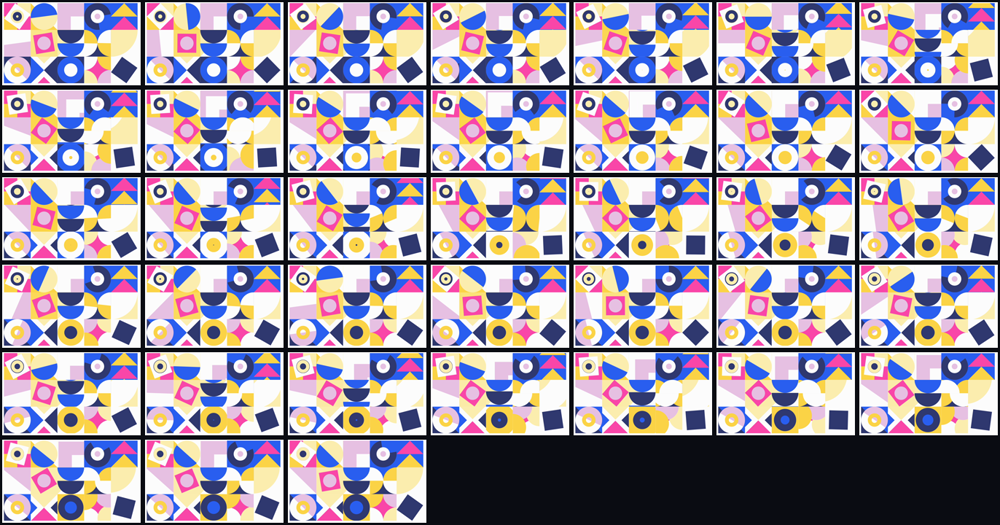
These are the only thing that costs image tokens (~300–400 each). The dense motion-energy curve that produced the timing above is pure arithmetic — effectively free. The numbers tell you when; these frames tell you what.
The numbers disagreed with the summary — and the numbers won
why motiscope hands perception to the model instead of guessing
motiscope’s whole-frame readout says
dominant easing: linear. That is the average across fifteen
tiles moving out of phase. Per tile, the angular velocity decelerates to near zero and ramps again:
a hard ease-in-out. Taking the one-line summary at face value would have produced a lifeless,
constant-speed grid. The report gives you the timing; you read the frames and the per-segment curve.
Verified, not asserted
the recreation was rendered back to video and re-measured with the same code
source     r1c2 burst peaks=[0.317, 1.067, 1.817]  intervals=[0.75, 0.75]
recreation r1c2 burst peaks=[0.433, 1.183, 1.933]  intervals=[0.75, 0.75]
Same beat. The 0.116 s offset is phase — the recording starts mid-loop — and the side-by-side above is shifted by exactly that much so the two play in step.
The fifteen tiles
every tile a different motif, all on one clock
| col 0 | col 1 | col 2 | col 3 | col 4 | |
|---|---|---|---|---|---|
| row 0 | rocking square + ripple target | half-disc rotating in a circle | L collapses / square blooms | pac-man, −90° per beat | triangle conveyor, scrolls up |
| row 1 | rotating half-plane | rocking square + circle | dome conveyor, scrolls down | pie wedge, +180° per 2 beats | quarter-disc scaling |
| row 2 | circle + rotating half + ring | four triangles pulsing | expanding ripple rings | four corner discs → 4-point star | rocking square |
The ripple is four discs growing 0→1 across the loop, phase-offset by one beat each, over a background whose colour steps in lock-step with whichever disc has just wrapped — so the wrap is invisible and the colours appear to march outward forever.
Only the palette changed
the timing transfers; the artwork doesn’t have to
| Source | Here |
|---|---|
#FCFCFC white | #FBF8F1 paper |
#295EEF blue | #17A2A2 teal |
#2F386F navy | #37244F plum |
#E6C0E2 lilac | #BFDCC6 sage |
#FBEDAE cream | #FBE3B8 sand |
#FBD346 yellow | #F5B335 amber |
#F946A8 pink | #F2584B coral |
What we guessed
honest examples teach more than perfect ones
- Rotation rates are quantised to the beat. Centroid tracking measured 235 / 197 / 143 / 134 deg·s⁻¹ for the four rotating tiles — no tidy ratios, and the centroid gets noisy on near-symmetric shapes. Each was snapped to the nearest beat multiple (360° per 2 beats, ±90° per beat), within ~10% of measured.
- Loop length is inferred, not observed — the recording never completes a cycle.
- Tile interiors are eyeballed from the curated keyframes. Radii, triangle proportions and corner-wedge sizes are within a few pixels, not exact.
- The half-plane sweeps continuously in the source; here it flips 180° per 2 beats.
- Rocking amplitudes (±9°, ±8°, ±14°) are estimates from the frames.
Two bugs this build surfaced
both from one root cause, and one of them only hurt the users who could least afford it
An element with a positive
animation-delay renders un-transformed until its animation starts.
- The 41 ms row stagger pushed rows 1–2 past
t=0, so every ripple ring drew at full radius and the topmost disc swallowed its tile. Fixed withanimation-fill-mode: both. - The
prefers-reduced-motionfallback usedanimation: none, which drops all transforms — the same collapse, permanently, for exactly the people who turn motion off. It now freezes on a real frame of the loop (animation-play-state: pausedwith a shared--toffset).
Reproduce it
the whole chain, from clip to SVG
motiscope analyze ambient_loop.mov --preset detailed   # -> report.md + curated frames
python3 generate.py > ambient-loop.svg                 # the build script, verbatim